
01 . Mindset
Trading Psychology:How your mind decides whether you pass or blow the challenge.
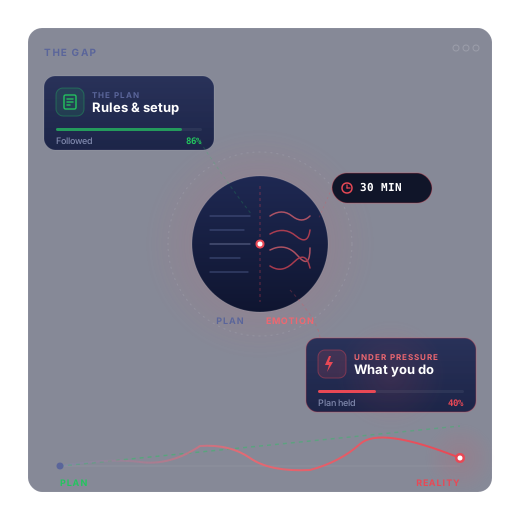
Most prop firm challenges aren’t lost to bad strategy. They’re lost in the thirty minutes after a losing trade. This is the working psychology layer every funded trader needs.
No hype. No signals. No fake promises.
The short version
01
Four emotional patterns blow more accounts than any technical error ever will. Most failed challenges trace back to the same handful of behaviors, not to a bad signal.
02
The Mark Douglas and Brett Steenbarger frameworks in plain language, with prop-firm examples , what the books mean when you have a real account on the line.
03
Why “control your emotions” is the wrong goal, and the system that replaces it. You don’t out-discipline your psychology. You build an environment where discipline wins by default.
04
The five mental patterns this pillar maps, ordered by how often they show up in blown accounts . so you fix the leak that’s actually costing you, not the one that sounds most interesting.
03
Definition
What is trading psychology?
Trading psychology is the study of how emotions, biases, and mental habits shape the decisions a trader makes under risk. It explains why a profitable strategy still loses money in real hands: the gap between a plan and its execution is almost always emotional, not technical.
What this means in practice
That gap is why two traders can run the identical setup and end the month with opposite results. One follows the plan when it hurts. The other improvises. On a funded account, where a single breached rule ends everything, the trader who stays mechanical wins by default.
Trading psychology sits inside Step 1: Prepare, the same stage as trader discipline, which turns these ideas into rules you actually follow.
04
Ecosystem
Step 1: The four mindset pillars
Four pages, four angles on the same problem. Each one fixes a different leak.
Trading Psychology
The mental game behind every decision.
● You are here
Trader Discipline
The rules and routines that hold when you don’t want them to.
Trading Mistakes
The errors that drain accounts before strategy matters.
Emotional Control
Staying functional in the moment a trade goes against you.
05
Scope
What this pillar covers?
Five mental patterns sit behind almost every failed evaluation. This pillar maps each one, then sends you to the deep-dive that fixes it.
01
Overtrading
02
Revenge Trading
03
Fear & Greed
04
Emotional Discipline
05
Impulsive Trading
Each pattern gets its own deep-dive below. Keep reading to see them in context.
06
The mental game
The model: trading is a probability game your brain refuses to play
Start with the part almost nobody internalizes: any single trade is close to random. Your edge is a statistical thing that only appears across a large sample, the same way a casino’s edge means nothing on one spin and everything over ten thousand. The trouble is your brain refuses to see it that way. It reads each result as a verdict. A win means you are good. A loss means you got it wrong. And it reacts accordingly.
Mark Douglas built his entire framework around fixing that misread. The idea is simple to state and hard to live: you accept the full risk of a trade before you enter it, so completely that no outcome can surprise you or move you off your plan. Once you truly accept that any trade can lose and that it costs you nothing emotionally, fear stops driving your hand. You stop yanking stops. You stop bailing early. You stop needing to be right. You think in probabilities instead of verdicts.
Brett Steenbarger adds the layer Douglas leaves implicit. You do not reach that calm state by deciding to feel calm. Telling yourself to relax under a tight drawdown has never worked for anyone. Steenbarger’s contribution is process: you build routines, checklists, and review loops that make the disciplined action the path of least resistance. The mindset is the output of the system, not the input.
Put the two together and you get the model for this whole pillar. Trading is a probability game. Emotion is what happens when you forget that and start grading yourself trade by trade. The fix is not willpower, it is structure that removes the moments where emotion gets a vote. Everything below is an application of that one idea.
Revenge trading: the real account killer
A loss is information. Your brain treats it as an insult. The sequence is predictable: you take a clean loss, anger and a need to get even flood in, and within minutes you are in a trade you would never have taken cold. The second trade is bigger, the setup is worse, and it is no longer about the market. It is about your ego getting square.
This is the most expensive pattern on a funded account, because prop firms do not care why you breached the daily loss limit. They care that you did. One revenge sequence after a normal stop-out turns a minus one percent day into a failed evaluation. The trader did not lack a strategy. They lacked a circuit breaker.
The fix is mechanical. Set a hard rule that after any loss you close the platform for a fixed window, and after two losses or a set daily loss you are done for the session. No exceptions, no judgment calls in the moment, because the angry version of you will not write good rules. We break the full protocol down in revenge trading.
Fear and greed: the two engines behind every bad exit
Fear and greed are not separate problems, they are two outputs of the same wiring. Fear shows up as fear of missing out, the late chase into a move that is already exhausting, and as the panic that makes you cut a winner early to lock in something, anything. Greed shows up as holding a loser in hope, oversizing after a good run, and refusing to take a clean profit because more felt available.
There is a measurable asymmetry underneath all of it: a loss hurts roughly twice as much as an equal gain feels good. That single fact explains the upside-down track record so many traders carry, small wins and large losses, an edge bled out by their own hand. On a challenge it shows up as a curve that never quite gets above water.
The counter is to decide the exit before the trade, while you are calm, so a live emotion never gets to make the call. A predefined stop and target take the held loser and the cut winner off the table at once. We go deeper in fear and greed.
Overtrading and impulsive trading
Overtrading is rarely about opportunity. It is about needing to feel in the game. A quiet session, a missed move, or plain boredom turns into a click, and the click was never a setup. Impulsive trading is the same reflex with a shorter fuse: the entry happens before the checklist does.
On a funded account this drains you two ways. The obvious one is commissions and small losses stacking up. The quieter one is the consistency rule. Most firms now reward profit spread across many controlled days and penalize the trader who churns. The fix is a hard cap on trades per session and a checklist that a setup either passes or it does not. Fewer trades, taken better, is not a slogan here, it is how the account survives.On a funded account this drains you two ways. The obvious one is commissions and small losses stacking up. The quieter one is the consistency rule. Most firms now reward profit spread across many controlled days and penalize the trader who churns. The fix is a hard cap on trades per session and a checklist that a setup either passes or it does not. Fewer trades, taken better, is not a slogan here, it is how the account survives.
Emotional discipline: from willpower to systems
Here is the reframe the rest of this page rests on. You do not fix trading psychology by feeling differently. Feelings are not reliable inputs, especially mid-drawdown. You fix it by building an environment where the disciplined move is the easy move and the destructive move is blocked before you can make it.
That means fixed risk per trade that does not flex with your mood, a hard daily loss cap, pre-set entries and exits, and a forced break after a loss. Decide all of it while you are calm. Then the rules trade, and your emotional state stops being the deciding variable. Emotional discipline is not a character trait you are born with. It is a structure you install.
revenge trading
Trading psychology How to Stop Revenge Trading (Before It Breaks Your Account)…
How to Stop Overtrading
Trading psychology How to Stop Overtrading: The Behavioural Fix That Holds Under…