
Trading psychology
How to Stop Overtrading: The Behavioural Fix That Holds Under Prop Firm Pressure
You already know you overtrade. You’re not here for a definition.
You’re here because the pattern keeps repeating. Eighteen good days, eighty percent of the target , and then somewhere between a missed setup and a small loss, four trades in thirty minutes ended a week worse than it started. Or phase one passed, phase two paid for, and the same rule broken you swore you’d never break again. Or it’s Tuesday afternoon, EURUSD is flat after London close, NY hasn’t kicked in yet, and you can already feel yourself about to force something.
The version of this article I’d have written five years ago would have told you to journal more and be more disciplined. That version was wrong, and I have the blown accounts to prove it. By the time your willpower has to do the work, the work is already lost.
This article is for traders on or about to take a prop firm challenge, where overtrading does the most damage in the shortest time. If you’re trading personal capital, the playbook still applies , only the urgency is different.
One position up front: journaling and “just take fewer trades” are structurally wrong as fixes. Both ask the trader to do the thing they’ve already failed at. The fix isn’t a stronger intention , it’s an environment that makes the bad trade physically harder to take.
- What overtrading actually looks like in your account
- Why "just be more disciplined" doesn't work
- The seven triggers behind most overtrading
- The five-minute interrupt — for when the urge is already firing
- Environment design — making overtrading physically harder
- The Trader OS — three documents that stop overtrading at the source
- Why overtrading is especially fatal on prop firm challenges
- The 30-day protocol
- When overtrading isn't a trading problem
- The bottom line
- Stop overtrading before you pay for another challenge.
- FAQ
- How long does it take to stop overtrading?
- Is overtrading a sign I should quit trading?
- Can a trading journal alone fix overtrading?
- Does switching to higher timeframes stop overtrading?
- Is overtrading worse on prop firm challenges than on personal accounts?
- What's the difference between overtrading and revenge trading?
- Related articles
QUICK ANSWER
Overtrading stops when you remove the decision from yourself, not when you try harder. Identify which of seven specific triggers is firing your urge , revenge, boredom, greed, FOMO, deadline pressure, identity, or adrenaline , install one environment-level circuit breaker for that trigger, and run a five-minute interrupt protocol when the urge fires mid-session anyway. The habit takes about thirty days to break with structure, and indefinitely with willpower. Under prop firm rules, the cost of skipping the work compounds , overtrading breaches daily loss, drawdown, and consistency limits faster than any bad setup will.
What overtrading actually looks like in your account
Before fixing it, name it. The pattern shows up in four specific ways, and the one doing the damage isn’t always the one you’d guess.
The clearest version is more trades than your plan allows. Your written rules say three setups per session. You took seven. The extra four weren’t on the plan, and if you’re honest, you knew it by trade five.
The harder version to see is oversized positions. Same trade count, but two of them were 1.5x or 2x your normal risk. You’ll defend this as “high conviction.” It almost never is. It’s the same emotional acceleration as taking extra trades , it just expresses itself through size instead of frequency.
Then there’s re-entry after a stop , taking a loss, watching the market keep moving without you, and re-entering the same trade within minutes. This counts even if it’s only one extra position, because the trigger is the loss, not the setup.
The last version is trading outside your defined session. Your plan says London open only, and you opened a trade at 14:30 GMT because something looked good. By definition, that trade is outside your edge , you don’t have data on how your strategy performs at 14:30 because you weren’t supposed to be there.
The classic blowup sequence, the one I see almost every week in the trader communities I’m in, looks like this: stop on a London open breakout, re-entry on the 1m chart before the candle has even closed, second stop, reversal trade in the opposite direction that finally catches the move you should have just waited for. Three trades, two losses, one win that’s smaller than the two losses combined. The day started as a -0.5R session and ended as a -1.5R session. Nothing about the strategy was wrong. The first trade was a valid setup. The other two are the article.
If two or more of those descriptions cover your last losing week, you’re in the right place. For the full anatomy of what overtrading is and where it comes from, the parent guide on overtrading covers the definitional side. From here on, this article is only about stopping it.
Why “just be more disciplined” doesn’t work
Every overtrading article ends at the same advice. The reason that advice fails is the same reason the rest of this guide exists.
Discipline is a depleting resource. Self-regulation research has shown for two decades that willpower behaves more like a muscle than a switch , it tires with use. By the time the urge to overtrade hits, you’ve spent hours making small judgment calls: which setups to skip, where to move a stop, whether the data print changes anything, whether to size up. The discipline tank is low and the impulse is full. It isn’t a fair fight, and the fact that you “know better” doesn’t change the outcome.
Mark Douglas spent thirty years pointing at the gap between I know what to do and I do what I know. He was right, and traders still don’t close the gap , because the gap isn’t closed by knowing about it. Knowing about it is the part you’ve already done. The gap is closed by structure that doesn’t require you to remember it in the moment.
There’s a deeper mechanism underneath. Trading reliably triggers the brain’s reward system the way other action-based behaviours do , each entry produces a small dopamine response, win or lose, because the anticipation itself is the reward. Over months, the brain stops associating trading with profit and starts associating it with the click. Not trading begins to feel like withdrawal. This is why traders who clearly understand the cost of their behaviour still repeat it. The chemistry is doing more of the work than the logic is.
Jared Tendler frames this differently in The Mental Game of Trading , he describes tilt as having a profile, with specific signatures you can learn to recognize roughly 30 seconds before the bad trade. The trigger taxonomy below is one way to make those signatures explicit. Tendler’s version is more clinical; this one is more operational. They agree on the underlying point: the work is to catch the impulse at the signature stage, not at the click stage.
Journals don’t solve any of this on their own , which is the place I disagree with most trading educators in this space. A standard journal is reactive. You log the damage after it’s done. By the time you’re writing “shouldn’t have taken that,” the daily loss is on the books. Same with a daily trade limit set in a calm morning state: the moment you’re behind and emotional, this morning’s rule feels like a suggestion someone else wrote. Journals have a place in the system , but only when you use them differently from how they’re sold, which I’ll come back to.
The fix isn’t more willpower. It’s structure that removes the decision from yourself before the urge arrives. Everything below is built on that shift.
The seven triggers behind most overtrading
Most articles on this topic list four generic causes , FOMO, revenge, boredom, greed , and leave you to figure out which one you’re fighting. That granularity is too low to act on. The seven triggers below each have their own typical window, their own tell, and their own fix. The most useful thing you can do this week is figure out which two are doing the most damage to your account, because the same intervention won’t solve all of them.
Trigger 1 — Revenge: the loss you can’t accept
Window: five to thirty minutes after a full stop-out, especially on a setup you were confident in. In my own audit of the worst sessions I’ve had, the median time between the stop and the next entry was under four minutes. I had not yet stopped feeling angry, and that’s the point , the trade was already taken.
The tell: you’re not scanning for new setups. You’re looking for a way back into the trade you just lost.
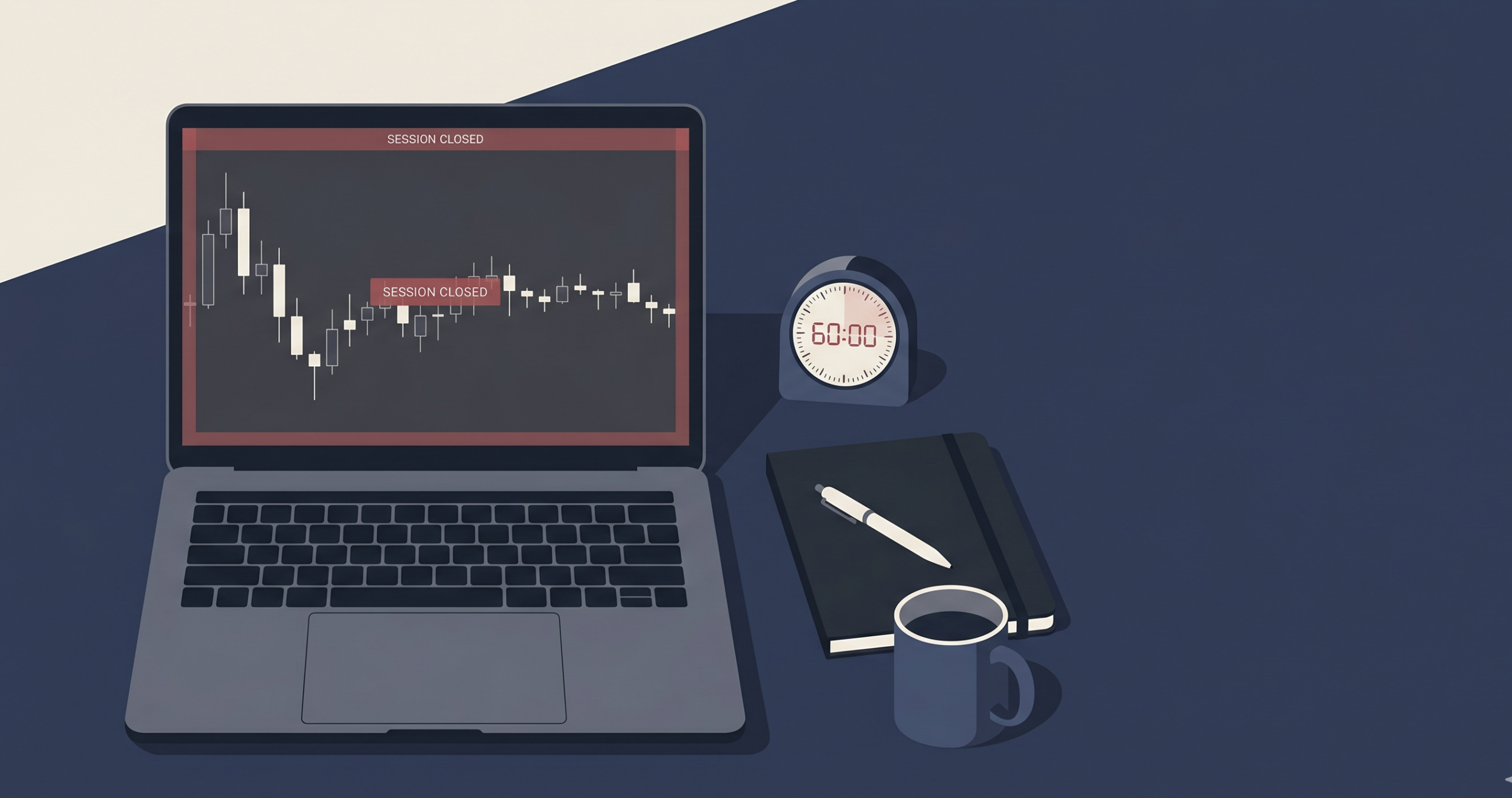
Fix: a hard sixty-minute platform lockout after any full stop. Not “I’ll take a break” , closed laptop, walked out of the room, phone timer running. The sixty minutes matters because revenge urgency burns off inside roughly that window for most traders. After it passes, you can look at the chart as a neutral observer instead of an angry counterparty.
For the full breakdown of this trigger, see revenge trading.
Trigger 2 — Boredom: the slow session
Window: mid-session in low volatility. The dead zone between 13:00 and 15:30 GMT on a typical Tuesday or Wednesday, when London’s done and NY hasn’t woken up. Indices grind sideways, forex majors sit inside the morning range, and there is no trade to take.
The tell: you’ve stopped looking at your usual instruments and started scrolling through ones you don’t normally trade. If you’re scalping EURUSD and you’ve just opened a chart on AUDCAD, you know what’s happening.
Fix: this is the hardest trigger because the solution isn’t trading-related. It’s having something to do that isn’t trading. Before the session opens, queue up a specific non-screen activity for slow periods , a workout, a walk, a book, anything that pulls you off the chart for thirty minutes without leaving you mid-task. The trap most traders fall into is staying at the desk during slow markets “just in case.” That posture is what kills accounts. Pre-commit to the activity before the boredom arrives, because by the time it arrives you’ll talk yourself out of leaving.
The structural version of this fix is timeframes. If you’re scalping five-minute charts and forcing setups through every quiet hour, switching even part of your bias to one-hour or four-hour structure removes most of the boredom surface area. It isn’t a complete fix , the other triggers still operate on any timeframe , but for traders who recognize themselves mostly in this category, it’s the single biggest lever available.
Trigger 3 — Greed: the winning streak
Window: after two or three winners in a row. Most often the final trade of an otherwise green day.
The tell: you’re up, you feel sharp, you’re sizing up “because the read is right today.”
Fix: a bank-the-day rule, defined in advance. Hit +2R or +3% on the day, the platform closes. Non-negotiable, because the moment you hit the number is exactly the moment you’ll want to negotiate. Most blown challenges happen after the daily target is hit, not before , trader hits the goal, takes one more trade “to push it,” and that trade is the one that breaches the consistency rule or eats half the day’s gains.
The prop firm dimension here is worth pausing on. Most major firms , FTMO, FundedNext, Topstep among them , enforce a consistency clause that caps any single day’s profit at 30 to 40 percent of total profit. One greed-fueled oversized winner can disqualify an otherwise-passed challenge after the fact. The rule catches overtraders in the winning direction, which most don’t see coming until it’s too late. We track the rule-by-rule breakdown across major firms in prop-firm-rules; the early pattern is that consistency-rule disqualifications outnumber drawdown breaches in the final week of phase one, which surprises almost everyone the first time they see it.
Trigger 4 — FOMO: the move you missed
Window: when you watch a clean directional move extend without you in it. Most common right after a missed setup you had identified but skipped.
The tell: you’re scanning for any reason to enter late, and the reason is starting to look more like a justification than a setup.
Fix: a percentage rule and a time rule, in that order. Don’t enter a move that’s already extended past a defined threshold for your instrument , roughly 0.3 to 0.5% for forex majors, 1 to 2% for indices, more for crypto. And if you didn’t take the setup at the trigger, wait fifteen minutes before considering anything. By minute fifteen, the move has either consolidated and offered a legitimate continuation entry, or it’s faded , and you’ve saved yourself from a top-tick chase that the chart is going to make look obvious in hindsight.
Trigger 5 — Pressure: the prop firm deadline
Window: final week of a challenge phase, especially when you’re behind the target.
The tell: you’re calculating how many winners you need to pass, and the math is starting to require oversized positions.
Fix: do the math the other way. A 5% profit target on a $100K account is $5,000. At 1% risk per trade, that’s five winners at 1:1 R, or three at 1:1.7. You don’t need to trade more , you need three good setups in five days. Most final-week failures come from traders abandoning their normal size and frequency to “catch up,” and the catch-up trades are the exact lower-quality setups the plan was built to filter out. If you genuinely can’t reach the target with your normal approach inside the time window, the answer is to reset the challenge or pick a firm with a longer evaluation. Not to overtrade out of it.
The full pass framework is in how to pass a prop firm challenge.
Trigger 6 — Identity: “I’m a trader, I should be trading”
Window: any session you haven’t taken a trade in yet. Often by mid-day if the morning was quiet.
The tell: you feel guilty for not trading. The session feels “wasted.”
Trigger 6 is the one I had to solve last. Revenge feels like a problem because it leaves an obvious mark on the account. Identity doesn’t , it feels like personality. The traders I know who beat overtrading mostly beat it in this order: revenge first because it’s the loudest, boredom next because the fix is mechanical, identity last because it requires you to redefine what “doing your job” looks like when the right answer is “nothing.”
Fix: this is a reframe more than a tactic. The illusion is that trading equals working. It doesn’t. Trading equals taking high-probability setups when they appear. If they don’t appear, the correct action is no action. Professional traders routinely have zero-trade days and consider them well-executed. Track skipped low-quality setups in your journal as wins. Over a month, the number of trades you correctly declined becomes more useful than your win rate, because it tells you whether the filter is working.
The deeper fix lives in your trading plan itself , if the plan defines success as following the plan, not as making money today, the identity problem dissolves on its own. The structure for that is in how to write a trading plan.
Trigger 7 — Adrenaline: you like the rush
Window: any time. This one isn’t situational.
The tell: you’re more interested in being in a trade than in being profitable. You feel restless without an open position. You trade differently , looser, more often , when nobody’s watching.
Fix: this is the trigger nobody admits to, and it’s the one where the honest answer matters most. If your relationship with trading is primarily about the feeling of being in a trade, no trading-side fix will hold for long. The structural changes in this article will buy weeks of improvement, but the underlying pattern resurfaces. The honest move is to separate the urge from the platform , put the adrenaline somewhere it can’t blow up your account (sport, exercise, competitive hobbies), and let trading become the slow, mostly-waiting activity it actually is at a professional level.
If you’re not sure whether this one applies, the gut-check question is simple: would you still want to trade if you knew, with certainty, your returns would be the same whether you took twenty trades a month or five? If the honest answer is no, this is your trigger.
The five-minute interrupt — for when the urge is already firing
The triggers above are prevention. This is for the moment you’re thirty seconds from clicking and you already know it’s the wrong trade.
Run all five steps. Three out of five doesn’t work.
First, stand up. Physically push back from the desk. Breaking the screen-locked posture interrupts the autopilot loop more than any thought does , the body change forces a state change.
Second, read your daily plan out loud. Not silently. Hearing your own rules in your own voice activates a different processing pathway than reading them in your head, which is why the out-loud version works and the silent version doesn’t.
Third, ask one question: would I show this trade to a prop firm reviewer and feel proud of it? The answer is almost always no. The question works because it externalizes the trade , it stops being your private decision and starts being a defendable action, and most impulsive trades don’t survive that test.
Fourth, set a five-minute timer. No clicking until it ends. Just watch the chart.
Fifth, reassess at minute five. If the setup is still valid by your written rules, take it. If anything has changed — and in roughly four out of five cases something has — pass.
The protocol works because it inserts time between the impulse and the action. That’s all it needs to do. The impulse doesn’t survive five minutes of forced observation.
Environment design — making overtrading physically harder
This is the section most articles on this topic skip, and it’s where most of the actual leverage lives. You can’t out-discipline a poorly designed environment, and you don’t need to discipline a well-designed one. Pick three of the changes below and install them before your next session.
At the platform level, disable one-click trading if your platform allows it. Set the maximum position size in the platform itself to your actual maximum, so an oversized entry physically fails rather than relying on you to catch it. Remove sub-one-minute charts from your workspace during the session , they exist mostly to manufacture setups that aren’t there.
At the browser level, open the broker tab when your session starts and close everything else. No email, no Discord, no Twitter, no second broker tab. The cleaner the screen, the lower the surface area for impulse.
At the schedule level, define a session end time and treat it the way you’d treat leaving an office. A physical timer that, when it rings, means the laptop closes. Not “I’ll wrap up soon.” Closed.
At the risk level, set a broker-side daily loss limit lower than your prop firm’s daily loss limit. If the firm’s daily loss is 5%, set your broker lockout at 3%. You get locked out before you breach the firm’s rule. A bad day costs you a day, not the account , and you’d be surprised how often that two percent gap is the difference between a saved challenge and a blown one.
At the phone level, delete the trading app. This is the most controversial item on the list, and it’s the most effective. The phone app exists to let you trade when you shouldn’t , in the car, in bed, at dinner. None of those are environments where you take A+ setups. If you genuinely need price alerts, those can come from an alerting app that doesn’t let you trade.
Individually these are small. Together they remove three or four impulsive trades a week. Across a month, that’s the entire difference between a passed challenge and a blown one.
The Trader OS — three documents that stop overtrading at the source
The triggers tell you why you overtrade. The environment prevents it physically. The Trader OS is what tells you, in advance, what counts as a real setup , so that “is this a valid trade?” stops being a real-time judgment call you can rationalize your way through.
Three documents. Written, not memorized.
The first is a pre-trade checklist , seven or fewer specific yes/no criteria a setup must meet before you take it. If any item is no, you don’t trade. The checklist exists so you can’t argue with yourself in real time. A working template is in the funded trader checklist.
The second is a trading journal used as a pre-mortem, not as an after-the-fact log. This is the part that turns the journal from decoration into a tool. Before each trade, write one sentence: what’s the specific setup, and what would make this a bad trade? Reading that sentence back before clicking catches more bad entries than any post-session review will, because the prevention work happens before the click. The full method is in how to journal trades.
The third is the trading plan, which has to include a hard maximum-trades-per-session number alongside your entry and exit rules. Most plans skip this. They define what a good trade looks like but not how many you’re allowed. Without that cap, you’ll find good-trade-shaped reasons for trade number eight. See how to write a trading plan.
Together, these make the decision before the session starts. By the time you’re at the platform, you’re not deciding. You’re executing.
Why overtrading is especially fatal on prop firm challenges
Overtrading on your own capital is expensive. On a prop firm challenge it’s terminal, because three specific rules compound against you in ways most traders don’t see until they breach them.
The daily loss limit — typically 4 to 5% — is the one most traders meet first. Two oversized revenge trades inside that limit will breach it before lunch. The blown challenge isn’t a slow erosion across weeks; it’s almost always a single bad day. We’re tracking blown-challenge anatomy across major firms in challenge-failure-analysis, and the early pattern is unambiguous — the breach is concentrated in a single session, and the session has a recognizable shape long before the rule trips.
The maximum drawdown, often trailing, is the one that catches the recovering trader. The line follows your equity up. Every winning day raises the floor. One bad overtrading session doesn’t take you back to start — it takes you below the trailing line. Traders who hit 7% profit and then blow up are almost always hitting the trailing drawdown, not the daily loss.
The consistency rule is the one most traders don’t know exists until they’re disqualified by it. Most major firms cap any single day’s profit at 30 to 40 percent of total profit. A greed-driven oversized winner can disqualify a passed challenge after the fact — the rule catches overtraders in the winning direction.
The combined math is unforgiving. A trader who overtrades on one day in twenty has a passing-quality strategy and a failing-quality result. The strategy isn’t the problem. The one day is.
The rule-by-rule breakdown by firm is in prop firm rules compared.
The 30-day protocol
You can agree with every section above and still overtrade on Monday. Reading isn’t installing. Below is the sequence that puts the changes into your week, with realistic expectations for what week two is going to do.
Days 1 to 7 — identification. Trade your normal approach. Don’t try to change anything yet. The only change is that every trade gets labelled with one of the seven trigger names from this article. By day seven, you’ll see clearly that two of the seven are doing roughly 70 to 80 percent of the damage. You’re building data, not fixing anything.
Days 8 to 21 — intervention. Pick your top two triggers. Install the specific fix for each — and only those. Don’t try to fix all seven at once; it collapses under its own weight. Expect a relapse somewhere between day twelve and day fourteen, when the initial motivation has worn off and the urge tests the new structure. That relapse is the part of the protocol where the habit actually changes — not a sign the system has failed. Log what triggered it. Reinforce the structural fix that should have caught it. Resume the next session.
Days 22 to 30 — consolidation. Deliberately reduce your trade count by 30% from baseline. Not because you have to — because you’re proving to yourself that fewer trades produces the same or better results. This is the step that breaks the identity-level attachment to volume. If your P&L is flat or up on a 30% reduced count, the lesson is internalized in a way no article can install for you.
By day thirty, you should have a clear, named relationship with your two main triggers and a structural fix that handles them. You’ll overtrade again at some point — under stress, after a long break, after a string of losses. That’s normal. The protocol isn’t about never overtrading again. It’s about catching it on trade two instead of trade eight.
When overtrading isn’t a trading problem
Most overtrading is a fixable habit. Some of it isn’t, and the honest move is to name that line clearly.
If you’ve installed the structural fixes, ridden out the relapse week, and you’re still trading outside your plan repeatedly despite continued losses — if you’ve started hiding losses from the people in your life, if a non-trading day produces real anxiety, if you’ve used money you can’t afford to lose to fund another challenge — the issue has moved past the trading desk. That isn’t a discipline gap. It’s behavioural, and the people equipped to help with it aren’t trading educators.
I’ve watched two people I respect leave trading entirely over this, and both of them were better technical analysts than I’ll ever be. Trading is one of very few activities that combines random reinforcement, financial stakes, and constant access — almost exactly the conditions that produce compulsive behaviour in people who would never develop a problem with anything else. Naming it early is the trader’s move. Speaking to a qualified professional is the trader’s move. Treating it as a journaling problem when it isn’t is what blows up accounts and lives.
The bottom line
Overtrading does not respond to willpower. It responds to structure: knowing which of the seven triggers you’re fighting, installing one environment-level circuit breaker for that trigger before your next session, and running the five-minute interrupt when the urge fires anyway. The thirty-day protocol is what makes it stick. The prop firm rules are what make the cost of skipping it enormous.
One specific permission before you close this tab: if you’ve blown three or more challenges with the same trigger pattern, the right move this month is not another challenge. It’s a thirty-day deliberate break from live trading while you install the protocol on a demo account. Most readers will not do this. The ones who do will save themselves another $1,500 in challenge fees and learn more from the break than the next challenge would have taught them.
One prediction you can test: if you install the sixty-minute revenge lockout and nothing else this week, you will feel the urge to overtrade somewhere between days four and six anyway. The lockout will catch you before trade two. That is the entire system working. Don’t expect more than that, and don’t accept less.
The traders who pass challenges aren’t the ones with the best strategies. They’re the ones who took fewer trades than the ones who failed.
Common mistakes to avoid
01- Trying to fix all seven triggers at once
The moment a trader recognizes themselves in the trigger list, the instinct is to install every fix on Monday morning — the 60-minute lockout, the bank-the-day rule, the deleted phone app, the 5-minute interrupt, all of it. By Wednesday, none of it is being followed. The system collapsed under its own weight, and the trader concludes “structure doesn’t work for me” when the real problem was trying to change five habits simultaneously.
The fix: Pick the two triggers from your seven-day log that account for the most damage and install only the fixes for those. Ignore the other five for now. Run the two fixes for a full thirty days before adding anything. Habit research is consistent on this point — installed behaviours stick when introduced in small, isolated changes, not in bundled overhauls. A trader who solves revenge trading and boredom trading in a month has fixed roughly 70% of their overtrading. The remaining triggers are easier to address from that stronger base.
02-Treating a single relapse as failure
Around day twelve to fourteen of the protocol, almost every trader has a relapse session — the structure gets tested under stress and one impulsive trade slips through. The mistake isn’t the relapse itself. The mistake is what comes next: the trader decides the system isn’t working, abandons it, and returns to old habits within a week. One bad session erases two weeks of progress because the trader interprets it as proof rather than as data.
The fix: Plan for the relapse before it happens. Write it into your protocol: “I will overtrade at least once between day 8 and day 21. When it happens, I will log the trigger, identify which structural fix should have caught it, and reinforce that fix the next session.” This reframes the relapse from a moral failure into a diagnostic event. The traders who break the habit aren’t the ones who never slip — they’re the ones who slip on trade two instead of trade eight, and resume the protocol the next session instead of abandoning it.
03-Relying on the trading journal to prevent overtrades
Journals are the most recommended overtrading fix on the internet, and they’re the most overrated when used the standard way. A trader logs each trade after closing it, writes a brief reflection, and assumes the act of journaling will produce better behaviour next session. It rarely does — because by the time the entry is logged, the impulsive trade has already happened and the loss is already booked. The journal documents the damage; it doesn’t prevent it.
The fix: Use the journal as a pre-mortem tool, not a post-mortem log. Before clicking the entry button, write one sentence in the journal: “This is a [setup name] at [level], and the specific thing that would make this a bad trade is [reason].” Reading that sentence in your own handwriting before clicking catches more bad trades than any post-session review will, because it inserts a forced cognitive pause exactly where the impulse normally wins. The post-trade review still has value for pattern detection over weeks, but the prevention work happens before the click, not after.
04-Solving overtrading with willpower instead of environment
The most common form of this mistake sounds reasonable: “I’m going to commit to taking only three trades per session.” The trader announces the limit, writes it on a sticky note, and trades trade four on Tuesday afternoon when the market gets interesting. The limit didn’t work because it lived only as an intention. Nothing in the environment enforced it. By the time the urge hit, the sticky note was a polite suggestion competing against a real impulse.
The fix: Convert every intention into a physical or platform-level constraint. “Take only three trades” becomes a broker-side daily loss limit set tight enough that a fourth losing trade locks the platform. “Stop trading after a stop-out” becomes a literal 60-minute kitchen timer and a closed laptop. “No phone trading” becomes the app deleted from the phone, not the app still installed with a promise not to open it. The principle: any rule that requires you to enforce it in the moment of temptation will fail eventually, because the moment of temptation is exactly when your enforcement capacity is lowest. Move the enforcement to the environment, where it works automatically.
05-Quitting the strategy instead of fixing the behaviour
After a few overtrading blowups, the typical move is to blame the strategy. The trader concludes their setup doesn’t work, abandons it, and buys a new course, joins a new mentor, or switches from forex to indices to crypto looking for a system that “fits them better.” A month later they’re overtrading the new strategy the same way they overtraded the old one — because the strategy was never the problem.
The fix: Before changing anything about your strategy, separate strategy data from behaviour data. Pull your last 30 trades. Mark each one as “in plan” or “out of plan.” Calculate your win rate and expectancy on the in-plan trades only. If the in-plan trades are profitable and the out-of-plan trades are where the losses live, your strategy is fine — the behaviour is the leak. Fix the behaviour with the protocol in this article before touching the strategy. Most traders who think they need a new system actually need to take the system they already have and execute it correctly for thirty days. If the in-plan trades are also unprofitable, then the strategy needs work — but you can’t know that until you’ve separated the two data sets.
THE STEP-BY-STEP PATH
Stop overtrading before you pay for another challenge.
Step 1 of the Steps To Fund path — trading psychology, discipline, and the trader habits that decide whether your next challenge passes or breaks the same way the last one did.
FAQ
How long does it take to stop overtrading?
About 30 days to break the behavioural habit with structural fixes, longer to shift the underlying identity. Expect a relapse around week two — that’s part of the process, not a sign it isn’t working. Willpower-only approaches don’t have a timeline because they don’t reliably work.
Is overtrading a sign I should quit trading?
No — but it’s a clear sign to stop trading live capital until the pattern is fixed. Most traders who quit because of overtrading didn’t have a strategy problem. They had an unfixed trigger and kept paying for new accounts to prove it.
Can a trading journal alone fix overtrading?
No, because journals are reactive — they record the damage after it’s done. Journals work as part of the fix, especially when used as a pre-trade tool rather than a post-trade log, but on their own they don’t prevent the next impulsive entry.
Does switching to higher timeframes stop overtrading?
Partially. Moving from 5-minute to 1-hour or daily charts removes most of the boredom-trading surface area and forces patience between setups. It’s not a complete fix because revenge, FOMO, and greed still operate on any timeframe — but for boredom-driven overtraders, it’s one of the biggest single levers available.
Is overtrading worse on prop firm challenges than on personal accounts?
Yes, because three rules compound against it specifically: the daily loss limit can be breached in a single overtrading session, trailing drawdown punishes equity giveback, and consistency rules disqualify outlier days even when those days are profitable. Overtrading that costs you 2% on a personal account can cost you the entire challenge on a funded evaluation.
What’s the difference between overtrading and revenge trading?
Revenge trading is a specific subtype of overtrading triggered by an immediately preceding loss. All revenge trading is overtrading. Not all overtrading is revenge trading — boredom, FOMO, and greed produce overtrading without any loss involved. The fix for revenge trading (60-minute platform lockout after stops) handles only that one trigger; the broader overtrading playbook is what you need for the rest.